I’ve watched vibration plates go through every phase imaginable—medical device, late-night infomercial gimmick, trendy gym accessory, and now a legitimate support tool many people use at home. Somewhere along the way, expectations got inflated and trust got shaky.
Here’s the grounded truth: a vibration plate isn’t magic—but it can absolutely support your health when used correctly and consistently.
What I like about vibration plates is that they make simple movement more effective. You don’t need fancy workouts. You don’t need to sweat buckets. You just need to use the right intensity, the right positions, and realistic goals.
Let’s talk about what vibration plates actually help with, who they’re best for, and what to watch out for.
How a Vibration Plate Works (In Plain English)
A vibration plate creates rapid oscillations that travel through your feet and into your muscles. Your body reacts by reflexively contracting and relaxing muscles to stay stable.
That reaction is where the benefits come from:
- More muscle fibers activate than with passive standing
- Stabilizing muscles work harder than you realize
- Circulation increases due to muscle pumping
- Light loading can stimulate bones and connective tissue
This is why vibration plates are often discussed in research around muscle activation, balance, and circulation—not just “exercise.”
Key Health Benefits of Using a Vibration Plate
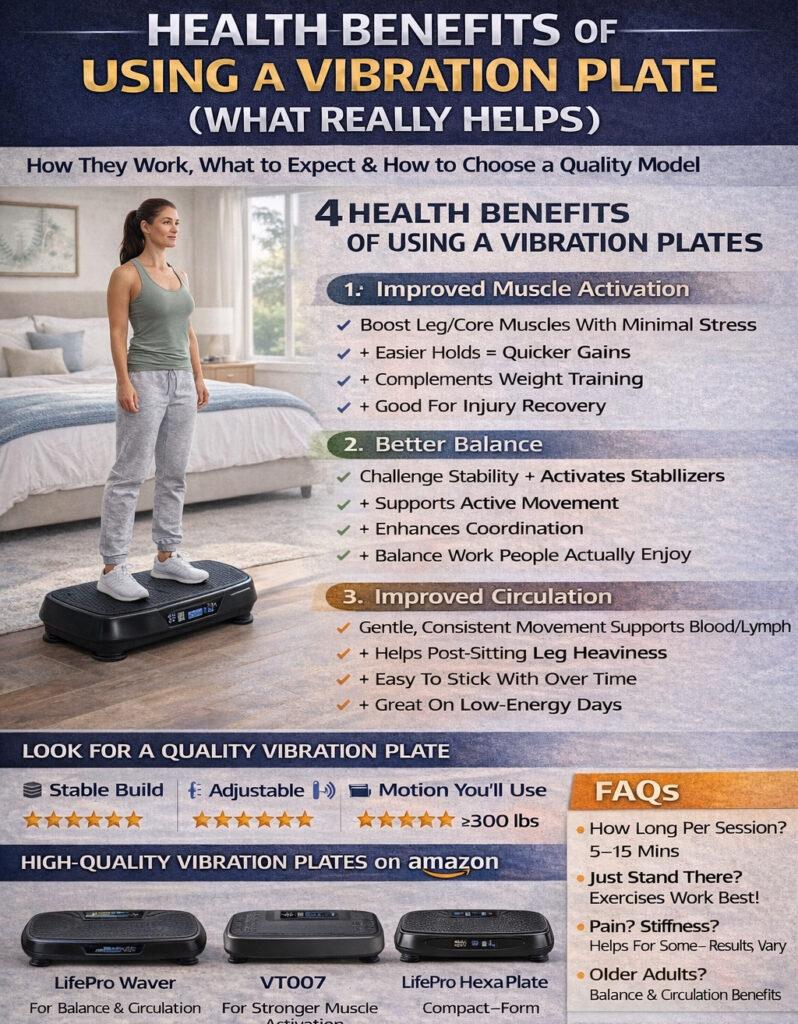
1. Improved Muscle Activation (Without Heavy Weights)
One of the most consistent benefits is increased muscle activation, especially in the legs, hips, and core.
Even basic positions like:
- standing with soft knees
- squat holds
- plank holds
can feel noticeably more demanding on a vibration plate. This is useful for:
- people easing back into movement
- those who can’t tolerate heavy loads
- days when you want stimulus without joint stress
This is why vibration plates are often used as a complement to strength training, not a replacement.
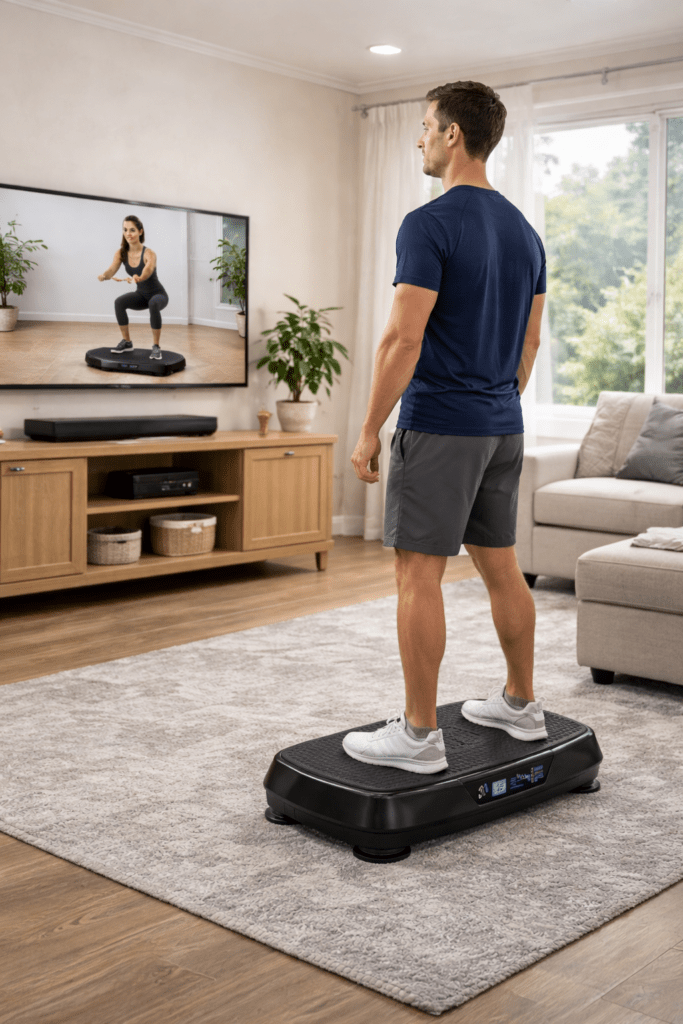
2. Better Balance and Stability
Side-to-side or oscillating vibration plates, in particular, challenge balance in subtle ways. Your ankles, hips, and core constantly adjust to stay upright.
Over time, this can support:
- better proprioception (body awareness)
- improved postural stability
- confidence with standing and movement
This is one reason vibration plates are commonly discussed for older adults or people focused on fall prevention and balance work. We cover balance-focused use cases extensively here.
3. Circulation and Lymphatic Support
This is one of the most underrated benefits.
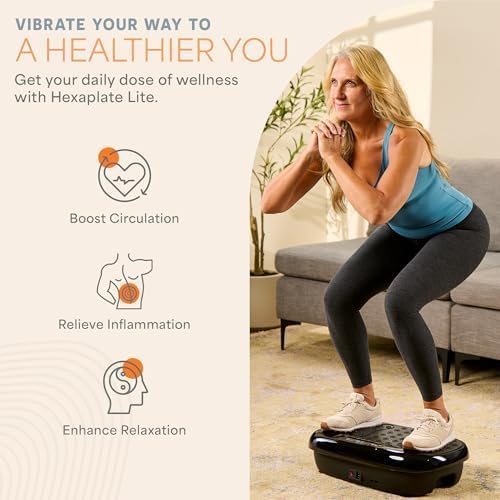
The rhythmic muscle contractions caused by vibration help move blood and lymph fluid—especially in the lower body. Many people use vibration plates for:
- leg heaviness
- prolonged sitting recovery
- general circulation support
Gentle sessions with feet on the plate or light standing can feel surprisingly refreshing. I specifically discuss this use case in more depth here.
This benefit is less about intensity and more about consistency and gentleness.
4. Joint-Friendly Movement on Low-Energy Days
On days when a full workout feels like too much, a vibration plate can keep you moving without impact.
That matters more than people think.
Consistency beats intensity. A 5–10 minute vibration session is often easier to stick with than a full workout, especially for:
- people with joint sensitivity
- those recovering from injury (with clearance)
- anyone rebuilding a movement habit
5. Support for Bone Health (With Caveats)
Some research suggests whole-body vibration may help stimulate bone tissue, particularly when used at specific frequencies and amplitudes. This is often discussed in the context of:
- bone loading without impact
- postural muscle activation
That said, this is not a replacement for resistance training or medical treatment. Think of it as a possible supportive stimulus, not a cure-all.
What Vibration Plates Do NOT Do (Realistic Expectations)
This part matters.
A vibration plate will not:
- melt fat on its own
- replace cardio
- replace strength training
- fix poor nutrition
Even the Mayo Clinic points out that whole-body vibration is best used alongside traditional exercise, not instead of it. If weight loss is your main goal, a vibration plate can:
- slightly increase calorie burn
- make strength holds harder
- support movement consistency
But diet and regular exercise still do the heavy lifting.
Features to Look For in a Quality Vibration Plate
If you want health benefits—not buyer’s remorse—look for these features:
1. Stable, Solid Build
A plate should feel planted, not rattly. Stability equals safer vibration.
2. Adjustable Intensity
You need low enough settings to start comfortably and higher options to grow into.
3. Motion Type That Fits Your Body
- Oscillating = gentler, balance-focused
- Vertical = more intense muscle activation
There’s no “best,” only what you’ll actually use.
4. Realistic Weight Capacity
Look for at least 300 lbs so vibration stays consistent under load.
5. Easy Controls
If adjusting settings feels annoying, you won’t use it consistently.
3 High-Quality Vibration Plates on Amazon
These are well-regarded options that cover different needs and experience levels:
- LifePro Waver Vibration Plate
- Popular for balance, circulation, and daily use
- Oscillating motion, beginner-friendly
- LifePro HexaPlate Lite
- Compact, versatile, good adjustability
- Solid choice for general health routines
- VT007 Vibration Plate
- Linear/vertical vibration style
- Often chosen by users wanting stronger muscle activation
Trade-Offs and Risks to Be Aware Of
Potential downsides
- Overuse can irritate joints
- High intensity too soon can cause dizziness or numbness
- Not appropriate for everyone
People who are pregnant, have pacemakers, recent surgeries, or certain cardiovascular conditions should consult a clinician first. See more on heart-related considerations here.
The biggest mistake
Chasing max intensity instead of comfortable consistency. More vibration is not always better.
Frequently Asked Questions
How long should I use a vibration plate each session?
Most people do well with 5–15 minutes, depending on intensity and goals.
Is it okay to just stand on it?
Yes—especially for circulation and warm-ups. Adding simple exercises increases benefits.
Can vibration plates help with pain or stiffness?
Some people find them helpful for gentle movement and circulation, but results vary.
Do vibration plates work for older adults?
Often yes, especially for balance and circulation, when used at appropriate settings.
Conclusion
The health benefits of using a vibration plate are real—but they’re supportive, not miraculous. When used correctly, a vibration plate can improve muscle activation, balance, circulation, and movement consistency with minimal joint stress.